


Say "Google" in an AI conversation and most people think of the search engine. The deeper truth is that Google has been working on AI since 2011, and that every breakthrough that exploded in the market from 2022 onward — Transformers, Attention, LLMs — came out of its research papers first. The real surprise isn't that Google entered the race; it's that it took so long to convert its research into product.
With the Gemini family, especially its multimodal branches, that gap has started to close. Google no longer offers just "a language model." It offers a unified mind that understands text, image, audio, and video inside the same context. For creators, that isn't a technical detail — it's a revolution in how you talk to a machine.

1. What does "natively multimodal" actually mean?
The phrase has become a marketing slogan, but its real meaning is precise. When a model is natively multimodal, it's trained from day one on diverse data together — images, audio, video, and text — not as separate stacks but as a single context. That's fundamentally different from taking a strong language model and bolting on a "mouth" that generates images separately.
The practical difference: when you upload an image to a natively multimodal model and ask "what does this woman feel?", the model doesn't analyze the image and then borrow a description from a separate language head. It understands the image and the question at once, and answers from a unified knowledge base. This shows up in answer accuracy, in "seeing and listening at the same time," and in the ability to edit by conversation.
The third-generation Gemini is among the purest models on that principle in the market today. GPT-5 and Claude 4 are getting close, but still rely on tighter visual pipelines.
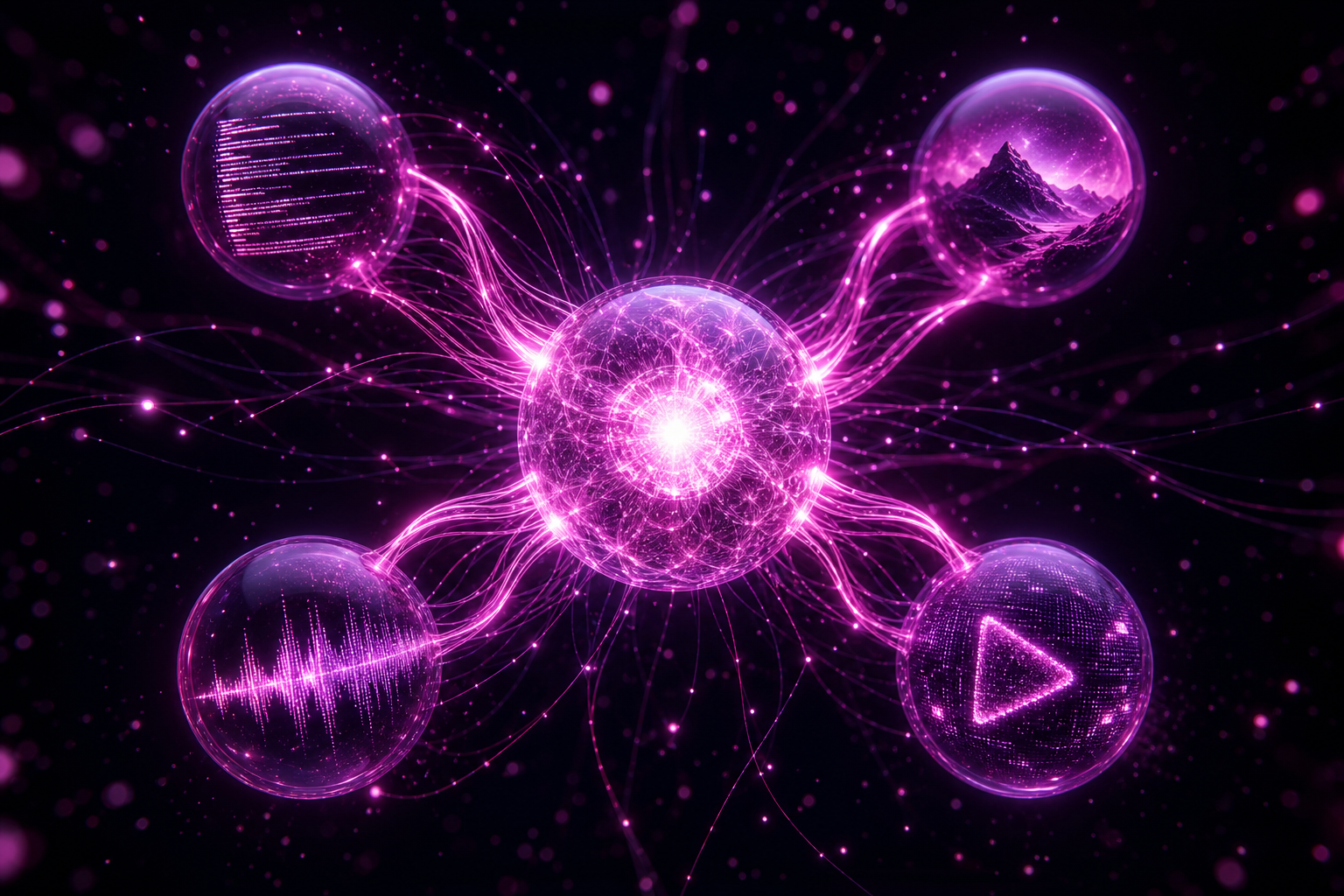
2. Gemini Omni: the real revolution — conversational editing
The standout capability of the modern Gemini family is Omni: the ability to work conversationally on multimodal content. Picture this scenario, which was impossible a year ago:
"Generate an image of a café in Old Damascus, golden light." Image arrives. "Add a cup of coffee and an open book on the front table." The updated version arrives, with the new details, preserving quality and style. "Now pull the camera back slightly to reveal the yellow wall." A wider frame arrives.
That's Omni: editing a scene by chatting, as if you were talking to a photographer and a designer at once. No prompt rewriting from scratch, no plugins, no post-production. The model understands you're asking for an edit, not a fresh generation.
The impact on creators is huge. A designer who used to spend an hour "prompt-tuning" can finish the same task in five minutes of natural conversation. A virtual cinematographer can "move around the scene" without rebuilding the whole world.

3. The tiers: from Ultra to Nano
Google doesn't ship one model. It ships a full pyramid so you can pick the right trade-off between quality, speed, and cost:
- Gemini 3 Ultra: the top-quality tier for demanding professional work. Slower and pricier, but the best result possible.
- Gemini 3 Pro: the daily-driver balance. Fast enough for interactive use, good enough for professional production in most cases.
- Gemini 3 Flash: the lighter, much faster tier, ideal for apps that need instant response or high-volume generation. Quality close to Pro at a fraction of the cost.
- Gemini 3 Nano: a miniature that runs directly on new Android devices with no internet connection. A revolution for privacy and field use.
This spectrum makes Gemini almost the only model usable from your personal phone all the way to a corporate data center, with one unified language and one API. Alone, that's a huge strategic edge over OpenAI and Anthropic.
4. Flash: the great economic shift
The most important economic innovation in the Gemini family isn't Ultra — it's Flash. Why? Because Flash flips the cost equation of AI.
Before Flash, apps that needed a lot of generation — summarizing thousands of documents, translating millions of messages, analyzing a million images — cost tens of thousands of dollars a month. With Flash, the same workload runs at a tenth of that, and faster. That opened a door to applications that weren't economically feasible.
For creators: Flash should be your first pick for repeated tasks (product descriptions, headline generation, first-pass edits). Keep Ultra for the final output that demands absolute quality.
5. Integration with the Google ecosystem
Gemini isn't a standalone tool — it's the backbone of the modernization of every Google product. Today Gemini lives inside:
- Gmail — summarization, drafting, smart Arabic replies.
- Google Docs — collaborative writing, rephrasing, contextual proofing.
- YouTube — descriptions, chapters, high-quality subtitles.
- Google Photos — conversational photo editing and semantic search.
- Android — an integrated assistant that understands screen and voice at once.
This integration gives Gemini an advantage OpenAI can't easily match: daily presence. A billion users use Gemini without knowing its name — because it simply lives inside the apps they open every morning.

6. Where Gemini genuinely excels
We wouldn't be fair without naming where Gemini out-runs its closest peers:
- Long-video understanding: Gemini can hold more than an hour of video in a single context. GPT and Claude aren't there yet.
- Fresh facts and search: thanks to search integration, Gemini updates its knowledge faster than most rivals.
- Rare languages: more than 100 languages at high quality, including Arabic in multiple dialects.
- Code: Gemini Code is one of the strongest programming models — used inside Google itself by Android developers.
- Cost: the performance-to-price ratio is noticeably better than most alternatives, especially in the Flash and Nano tiers.
7. Where Gemini still lags
No flattery. Gemini struggles in a few places:
- Free creative writing: for literary or poetic writing, many comparisons still favor Claude and GPT on subtle stylistic nuance.
- Over-cautious safety: Gemini sometimes refuses perfectly safe requests with tortured reasoning, which irritates advanced users.
- Developer UX: while improving, OpenAI's developer surface is still cleaner and faster to learn.
Google knows these points and is working on them. But fairness demands we name them instead of pretending Gemini is "the best, period."
8. What does Gemini mean for Tamaem and the Arabic user?
On Tamaem, we treat Gemini as a layer of everyday intelligence. When you type your ad idea in Arabic, the model understands the cultural intent, not just the literal translation. When you request music for a Ramadan campaign, we don't need to explain what "Ramadan" means. When you upload your product image, Gemini understands the cultural background of the Arabic market.
These aren't marketing lines — they're a direct result of Gemini being trained on Arabic data more deeply than many rivals. Google invested here because Arabic is a huge market for its services.
9. A question we leave with you
Do you want your relationship with AI to happen through separate tools you pick yourself, or through a unified system that lives inside every app you already open?
That's the real question Gemini asks. Google is betting on the unified system — AI "breathes" inside everything you use, without ever opening a separate app. Your answer shapes your relationship with technology for years to come.
On Tamaem we blend both models: you can access Gemini-class capabilities as a standalone tool inside our platform, while preserving a unified Arabic-first experience that respects your culture and language. Try it, then come back and tell us: did Gemini understand you, or only understand the English translation of your ideas?