

Open a creator's toolshed in early 2026 and you'll see something strange: five subscriptions, seven apps, three tabs always open, and a desktop folder full of files whose names half the time make no sense. A filename like "final_v3_real_use_this.mp4" isn't a joke — it's a distress signal.
This is the real problem that defines 2026: not a shortage of tools, but a fragmentation of tools. Every lab ships a great model, then builds its own UI, pricing, and rules around it. The result: the user — the artist, the designer, the creator — turns into a technical project manager instead of staying creative. This article is about escaping that chaos.
1. The big crime: how did we get here?
This fragmentation wasn't deliberate. It happened naturally: as the generative AI wave took off, every lab started from a different corner. OpenAI came from text, Stability AI from images, Suno from music, Runway from video. Each built a UI that suited its specialty, launched its own subscription, and defined its own license.
At first this was acceptable. Who really needs "music" and "video" and "images" in one project? By 2025, every serious marketing campaign needed all three at once. An Instagram Reels account needs a video, a cover image, a background track, and persuasive copy — all in one hour, several times a week.
That's where the problem exploded. A creator opens Midjourney for an image, copies it to Runway for a video, opens Suno for music, goes back to Photoshop to touch up, then into an editor to combine it all. Seven tools, five bills, ten upload cycles. A one-hour production becomes a six-hour production because most of the time is spent switching tools.
2. Why did earlier solutions fail?
Attempts to unify tools aren't new. Adobe tried with Creative Cloud, Canva tried with a simpler UI, Notion tried with the "everything in one place" pitch. Why did none of them fully solve it?
- Adobe: collected the tools but stayed heavy, expensive, and complex for non-professionals. You still need to learn separate UIs inside the same subscription.
- Canva: made things easy for beginners but stayed limited on deep generative capabilities. Good for quick design, weak for professional production.
- Specialists: when Midjourney added video or Runway added music, the results lagged the specialists. Each lab is strongest in its original discipline.
The lesson: a unifier won't win by reinventing everything. It wins by bringing the best of the market into one UI, with a unified experience for credits, context, and history.
3. What changed in 2026: three pillars matured
The decisive gap between 2025 and 2026 is the maturity of three technologies that made a truly unified stack possible:
- Unified APIs: a single platform can now reach FLUX, Ideogram, Suno, and Midjourney over unified interfaces. Building a "stack" no longer means rebuilding each model — it means intelligent routing.
- Multimodal understanding: models like Gemini 3 and GPT-5 can coordinate text, image, and audio. One idea produces three coherent outputs, not three separate projects.
- Cheaper cloud compute and safer infra: what needed a whole lab in 2022 now runs on one server. That means smaller platforms can offer capabilities that used to be reserved for giants.
These three pillars together are what made 2026 the tipping point for unified platforms. Before this, it was a dream — now it's a practical option.
4. What "unified creative stack" actually means
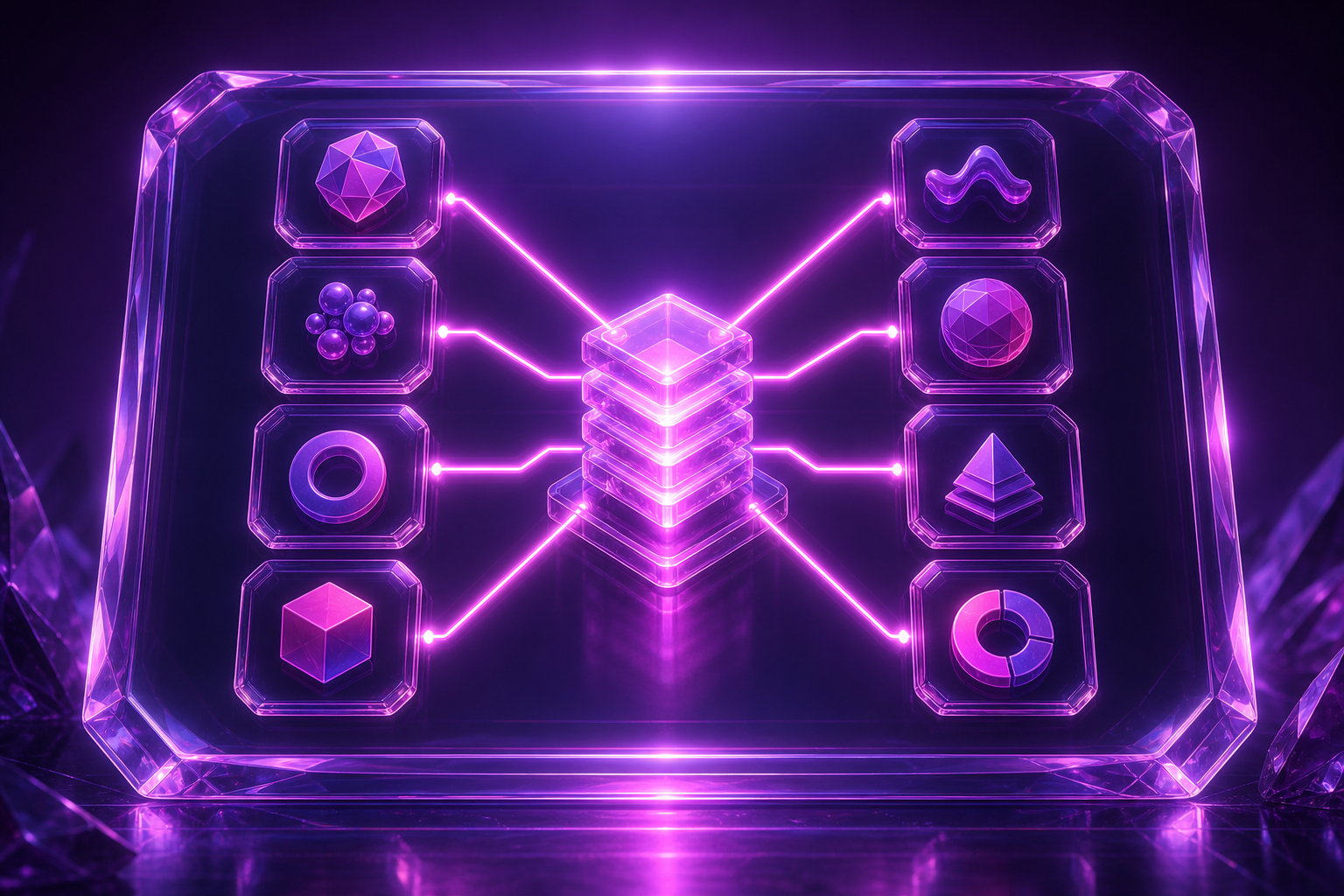
To keep this from staying a marketing phrase, let's spell out what a real stack means:
- One UI: you don't open five apps. You open one tab and say what you want.
- One credit pool: one top-up covers everything. No juggling five digital wallets.
- One context: the image you just generated can become the reference for the next video with a click. No downloads and uploads.
- One history: all your outputs in one place, searchable and organizable. No chaotic desktop folder.
- One identity: your colors, type, style — stored once and applied automatically to any new output.
- One license: a single legal doc defining what you can do with everything you generate. No legal scavenger hunt.
These six pillars are the difference between "a pile of adjacent tools" and "a unified creative platform." That's not a visual difference — it's a completely different experience.
5. The rise of vertical platforms
Here's the twist: the unified stack doesn't mean "one giant platform that replaces everything." The giants (Adobe, Google, Microsoft) have scale advantages but are slow to adopt the latest models, and their UIs are complex for beginners.
What's actually happening is the rise of vertical platforms for each audience:
- Platforms for ad creators.
- Platforms for digital artists.
- Platforms for podcasters and video creators.
- Platforms for music makers.
- Platforms for Arabic creators — that's where Tamaem sits.
Each platform picks the models best suited to its audience and builds a tailored experience around them. The competition isn't "who collects the most models," but "who understands their audience the deepest."
6. Why does the Arabic market need an Arabic-first platform?
Fair question: why isn't it enough to use Adobe or a translated version of an American tool? The answer goes beyond language:
- Cultural understanding: "Ramadan ad" or "Eid design" isn't just a word translation — it's an entire cultural context the model has to grasp.
- Arabic typography: many tools support Arabic "technically" but poorly handle its shaping and flexibility. An Arabic platform knows the difference between a Tajweed script and a Ruq'ah.
- Right-to-left layout: the UI itself must breathe in Arabic, not be mechanically flipped from English.
- Local payment methods: not every Arab has a US Visa. An Arabic platform enables local payment rails.
- Local support: support teams that read your complaint in your language, without a barrier.
7. How do you pick the right platform?
Six practical questions reveal the best platform for you:
- What are your primary outputs? Video → a video-strong platform. Ads → a platform focused on in-image text.
- What's your monthly budget? Some platforms optimize for economics, others for max quality.
- What's your working language? UI language matters more than most people realize.
- What's your technical level? Advanced platforms for pros, simple ones for the rest.
- What commercial license do you need? Read the terms before subscribing.
- Do you need team collaboration? Some platforms support it, some don't.
8. Where Tamaem fits in this wave
Tamaem wasn't built to be "Arabic Adobe" or "Arabic Canva." It was built to be the first creative stack designed in Arabic — from the first idea to the final output, inside a unified experience that understands you.
What we bring together in one place:
- Music generation with the latest global models, with understanding of Arabic musical patterns.
- Image generation with the best 2026 models (FLUX, Ideogram, Recraft, Gemini), with deep support for Arabic typography.
- Video generation with leading models focused on quality and speed.
- Conversational image and video editing via Gemini Omni.
- A right-to-left Arabic UI, designed natively rather than translated.
- Local payment methods, Arabic support, and clear commercial rights.
The goal isn't to compete with Midjourney or Suno — it's to bring them within reach of Arabic creators, without barriers.
9. A question we leave with you
How many hours of your weekly production actually go into "tool management" instead of real creation?
Count honestly. If the answer is more than 20%, you're not a content creator — you're a technical project manager. A unified stack isn't a luxury; it's the difference between a creator who spends hours creating and a creator who spends hours jumping between apps.
Try Tamaem yourself. Build a full idea — image, video, music — in one flow. Then come back and tell us: did it feel like you were finally creating, or that you were still managing a project? Your answer maps the future of the whole industry.