

Only a few years ago, saying "AI is singing" felt like a lab joke or a niche demo. In 2026, AI-generated singers are climbing playlists, reviving voices of the departed, and releasing entire albums whose melody, lyrics, and vocals were never touched by a human. The question stopped being "can it?" and quietly became something far more uncomfortable: "is it winning?"
This article isn't an academic lecture or a marketing prophecy. It's an honest invitation to think. We'll walk through what an AI is actually doing when it "sings," where it now genuinely outperforms humans on measurable dimensions, and where the human voice still holds ground — perhaps forever. And at the end, we hand the question to you: whom does your ear trust more — a person who breathes, or a model that has memorized every breath?
1. What does it mean for a machine to "sing"?
When we say AI sings, we're actually bundling three distinct technologies under one label: text-to-speech synthesis, voice cloning of a specific person, and full song generation from a short idea or even a single word. The gap between "speak in my voice" and "write and sing me a song about longing for Damascus" is enormous — but the listener never sees it.
Modern AI singing rides on networks trained on millions of hours of real human vocals. The network doesn't know love or heartbreak; it knows how to move frequency and a digital larynx in a way that makes a human brain believe it hears emotion. That fine distinction will matter later, when we talk about "soul."
2. From Vocaloid to Suno v5: a decade of progress in two years
For those who think this arrived last month: it started seriously back in 2007 with Vocaloid and the virtual singer Hatsune Miku, who packed Japanese stadiums with real audiences cheering a synthetic voice. But that voice was almost instantly "machine-like." Ears knew.
Then came the diffusion-model and multimodal boom of 2022–2024: MusicLM from Google, Riffusion, Suno, Udio. In a single year we jumped from 15-second experiments to full three-part songs with bridges, in Arabic, English, Spanish, and Korean at once. Suno v5 and Udio v2 delivered, for the first time, samples that an untrained ear cannot reliably identify as artificial.
The real leap wasn't only in quality — it was in access. Anyone with an idea can now walk away with a finished track before finishing morning coffee. That shortcut is redrawing the rules of music: distribution, discovery, and even the definition of "artist."
3. Where AI already outperforms humans
Let's be fair — there are dimensions where the human is no longer a real competitor. Not because art disappeared, but because the machine is playing an entirely different game.
- Absolute consistency: a model can sing for ten hours without a scratch in the throat, take one and take one hundred sounding identical.
- Vocal range: not bounded by physiology; it can leap from a deep bass to falsetto with no training and no fatigue.
- Production speed: what a studio needs a week for — writing, tracking, mixing, mastering — a text box can deliver in seconds.
- Instant personalization: a mother can generate a lullaby with her baby's name; a company can craft a brand jingle stamped with each customer's ID — no studio, no singer.
- Cost: producing "professional-sounding" music is now nearly free. That alone flips the industry's economics.
- Rare languages: modern models sing in Modern Standard Arabic, dialectal Arabic, and in languages whose professional singer pool is tiny.
These aren't marginal perks; they redraw the access map of music. An unknown creator in a remote town no longer needs a label to put their sonic idea out.
4. Where the human still wins
The ear isn't a neutral instrument. When we listen to a song we're not just decoding frequencies — we're absorbing a story. This is where the human quietly reclaims the field.
A real singer carries weight no benchmark measures. When Umm Kulthum drew out a phrase for minutes, she wasn't showing vocal capacity; she was transferring fifty years of Cairo life into your chest. When Fairuz mourns Damascus, we cry with her because she really cried. A model can mimic the outcome — but it doesn't own the reason.
Other things still belong to humans:
- Deliberate imperfection: a fleeting quiver, a broken note in the final line, a breath before the word — those aren't mistakes. They're the signature.
- Live presence: a concert isn't an audio file; it's sweat, a shaky syllable, a real-time contract with an audience. Nothing yet emulates it.
- Moral weight: when a singer sings about their cause, the song becomes a stance. A model has no stance — only probabilities.
- Rooted culture: Arabic maqam, Quranic recitation, flamenco, qawwali — those are living generational memories, not sample banks.
- Artistic decision: an artist chooses to leave a phrase unfinished, to celebrate a flaw. A machine always chases "statistically better."
That's why, when you hear the best AI vocals today, something inside you — if you pay attention — mutters: "beautiful, but a bit too smooth." A well-trained ear catches it: a voice that never errs, never tires, never forgets — a voice that hasn't lived.
5. The strange loop: crying to a song no human sang
And yet, the unexpected happened: people are actually crying to songs no human ever sang. "My grandfather's voice, restored by AI" is now a viral genre on TikTok. Comments like "it felt like it was written for me, even though I know it's from Suno" have become normal.
The reason is simple: the ear doesn't analyze, it feels. However loudly the mind repeats "this is a model," a vibration that touches a memory string still lights up memory first. This isn't a defeat for human art — it's proof that art lives less in the source and more in the listener.
Still, the ethical question returns: if I can generate a song that makes you cry in one minute, is that art, or is that emotion manufacturing?
6. The darker side: cloning, rights, and rulings
With capability comes responsibility — and chaos. Today a teenager with no experience can clone a famous singer's voice in minutes and make that voice sing something the artist never approved. It has happened to Arab and Western stars alike, and record labels have entered long legal battles.
Questions no one was asking two years ago are now urgent:
- Is "voice" a form of intellectual property independent from the song?
- What is the ruling on singing in the voice of a deceased person without the family's consent?
- May a platform train models on a singer's catalog without a contract?
- And finally: does listening to a song no human sang stay inside "entertainment" — or does it enter a different moral territory?
There are no clean answers yet — legislation is chasing the industry, and religious/ethical rulings are chasing too. But the direction of ethical platforms is clear: a model-side audio watermark, prior consent, and clear rights for the original voice owner.
7. Tamaem: where the two voices meet
On Tamaem we don't frame AI as a replacement for the singer — we frame it as a bridge. A lyricist can test an idea in thirty seconds before pitching it to a real singer. A small podcaster can open their show with a piece of music that carries their name. A brand owner can prototype ten sonic identities and then hire one artist to finalize the winner.
That's the usage we consider healthy: tools that free the idea, not tools that displace the soul. The overwhelming majority of Tamaem users today don't want to erase singers — they want to erase the wall between "I know there's a song in my head" and "I can finally hear it."
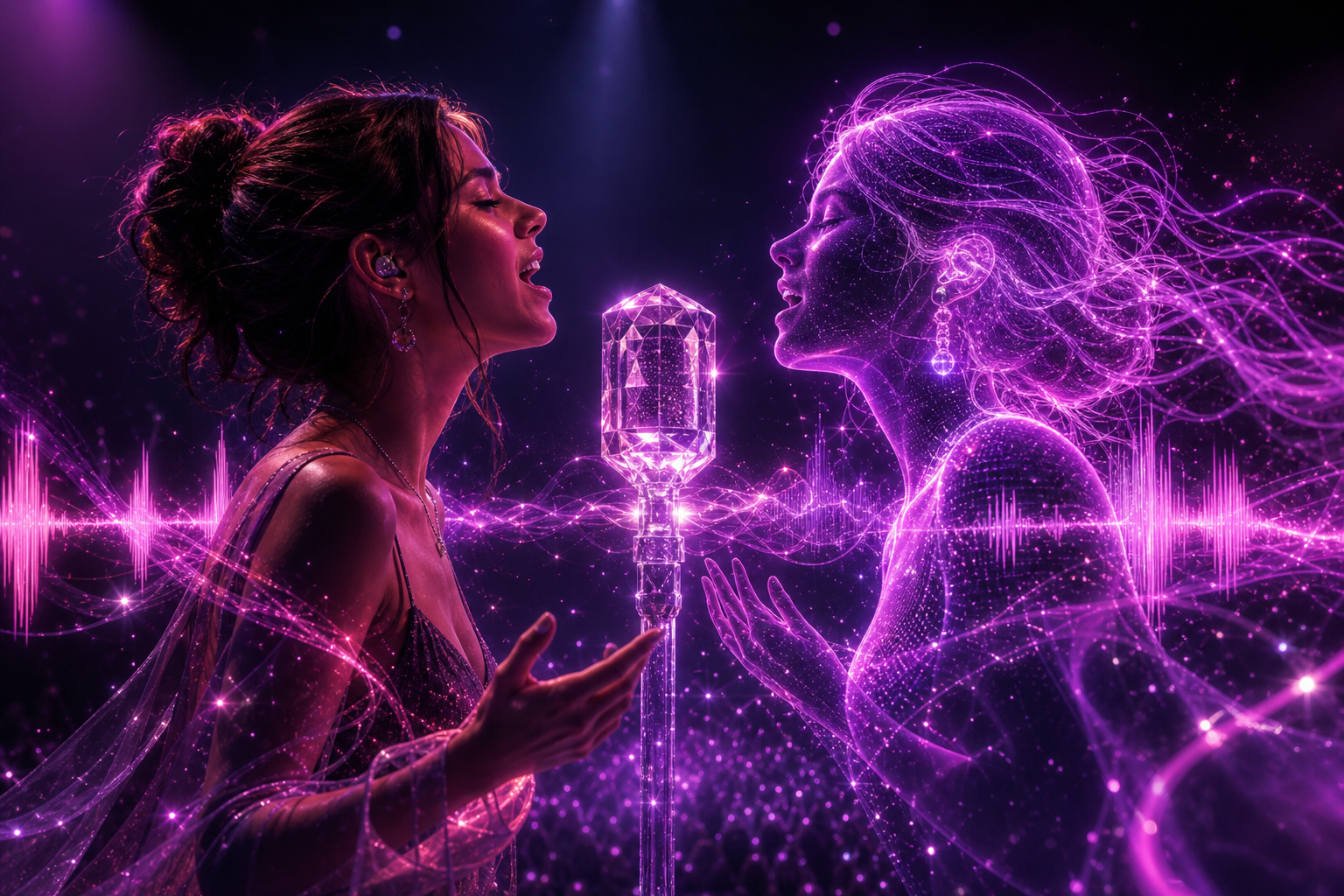
8. So, in your opinion — who wins?
The best thing about this debate is that it doesn't resemble the calculator-vs-brain argument. A calculator can't make you homesick. An AI song can. Which is why the answer to the headline question isn't technical — it's deeply personal.
Does AI outperform human singers, in your opinion?
Try to answer honestly before scrolling further. But let us help you with four questions that reveal your real position:
- If you heard two versions of the same song — one by a singer you love, one AI — and blind tests showed you can't tell them apart, does that difference still matter to you?
- Would you include an AI-generated song in your own "funeral playlist"?
- If your child produced their first song with AI, would you feel proud — or confused?
- Is there a departed singer you love so much that you would never allow anyone to "resurrect" them digitally, even with the family's blessing?
Your answers to those four questions say more about you than about the technology. They talk about your relationship with art, with memory, and with the idea of whether a voice belongs to a person — or to a civilization.
9. Closing: not a battle — a trio
The likelier future isn't "human beats machine" or "machine cancels human." It's a trio: the artist remains the source of the idea and lived experience, the machine becomes a fast editor that loosens capital's grip on production, and the listener reclaims a role long stolen from them — choosing what they love, not what the industry drops onto their playlist.
On Tamaem, that's the story we want to write with you: an Arabic-first platform that knows singing is human at its core, yet isn't afraid to hand you the tools of this era. Try producing your first track today, listen honestly, then come back and tell us: in your ear, who won — the human, or the machine?