

Cast your mind back to 2022, when DALL·E 2 launched to the public. You'll remember the feeling of magic: this machine draws whatever you type. But the images were noisy, faces often twisted, and text inside images just scribbles. Fast-forward to 2026 and the state of things is incomparable. AI image generation is no longer an "experimental feature" — it's a full industry, billions of dollars deep, with models that rival the best human photographers and designers on specific tasks.
This article isn't a shallow list of names. It's a deep read of the current market: who leads in each category, why, and how to pick the perfect model for your project without drowning in dozens of options. We'll walk through six practical criteria, seven leading models, and four areas where AI will become the default design pathway by 2027.
1. What fundamentally changed since 2022?
The gap between today's models and those from three years ago isn't incremental — it's categorical. Five key shifts:
- Text inside the image: what was impossible in 2022 (writing a legible English word inside the image) is routine in 2026 (logos, ad posters, headlines in multiple languages).
- Faces: models no longer bend noses or sprout extra fingers. Faces are natural — sometimes exaggeratedly "perfect."
- Consistency: you can now generate the same character across ten different images while keeping the features. That opens the door to full illustrated storytelling.
- Style: models can now precisely imitate famous photographers' looks, sparking major legal and ethical debates.
- Language understanding: the model doesn't just react to keywords — it understands complex sentences in full context, closer to a "design partner" than a tool.
Together, these shifts turned generative models into a daily working tool for designers — not a novelty.
2. The 2026 top players
We can't cover every model, but seven names dominate serious decisions:
- Midjourney V7: still the aesthetic reference. The most beautiful images, the most "artistic" style, and a devoted user base. Its Discord-based UI still hampers professionals, and commercial rights aren't always fully clear.
- Black Forest Labs FLUX Ultra: the model that wins most fine-art comparisons in 2026. Exceptional quality, wide stylistic range, and photoreal outputs that others struggle to match.
- Ideogram 3.0: the undisputed king of in-image text. If you need an ad poster with precise Arabic or English inside the image, Ideogram is the pick.
- Recraft V3: the model design studios fell in love with. Focused on consistent identity, vector-exportable illustrations (SVG), and production-ready commercial designs.
- Google Imagen 4 / Gemini Image: very high quality with unprecedented contextual understanding of complex instructions. Correctly handles "move the table closer to the yellow wall" — harder than it looks.
- ByteDance Seedream: the fast-rising Chinese model, with quality near FLUX at a lower cost, especially strong on Asian scenes.
- OpenAI GPT-Image: part of the GPT family, easy to use, but still trailing FLUX and Midjourney on top-end art.
3. Typography inside images: Ideogram's coup
Two years ago, an image with a single word rendered correctly was tweet-worthy. Today, Ideogram generates ad posters with full sentences, multiple typefaces, different sizes, correct alignment, and in multiple languages including Arabic, Chinese, and Korean.
That single change flipped the ad industry. A designer who spent two hours setting up a daily ad (background, text, alignment, formatting) can now generate ten variants in half an hour and pick the best. Ideogram 3.0 specifically improved Arabic typography noticeably — important news for our market.
To be fair: rivals are catching up. FLUX Ultra is very good at text now, and Gemini Image is closing the gap every couple of months.
4. Consistent identity: Recraft's real win
If you run a brand, your real problem isn't the quality of a single image — it's style stability across hundreds of images. A pretty poster isn't enough; every image in the campaign must feel like the same visual soul.
That's where Recraft shines. The model lets you build a "Style Kit" that preserves your colors, type system, and design language across every image you generate. Result: a million images, one identity. That's what a company running dozens of weekly campaigns actually needs.
The other edge: Recraft exports as SVG — editable vector artwork. Your designer can open the file in Illustrator and tune the details. That's a rare capability, and thousands of pro designers rely on it now.
5. Free-form art: the Midjourney vs FLUX fight
If you're an artist, a book cover designer, or a high-end ad photographer, you're in a different arena. Typography and consistency don't matter. Only vision matters. Which model makes you say, "this is art."
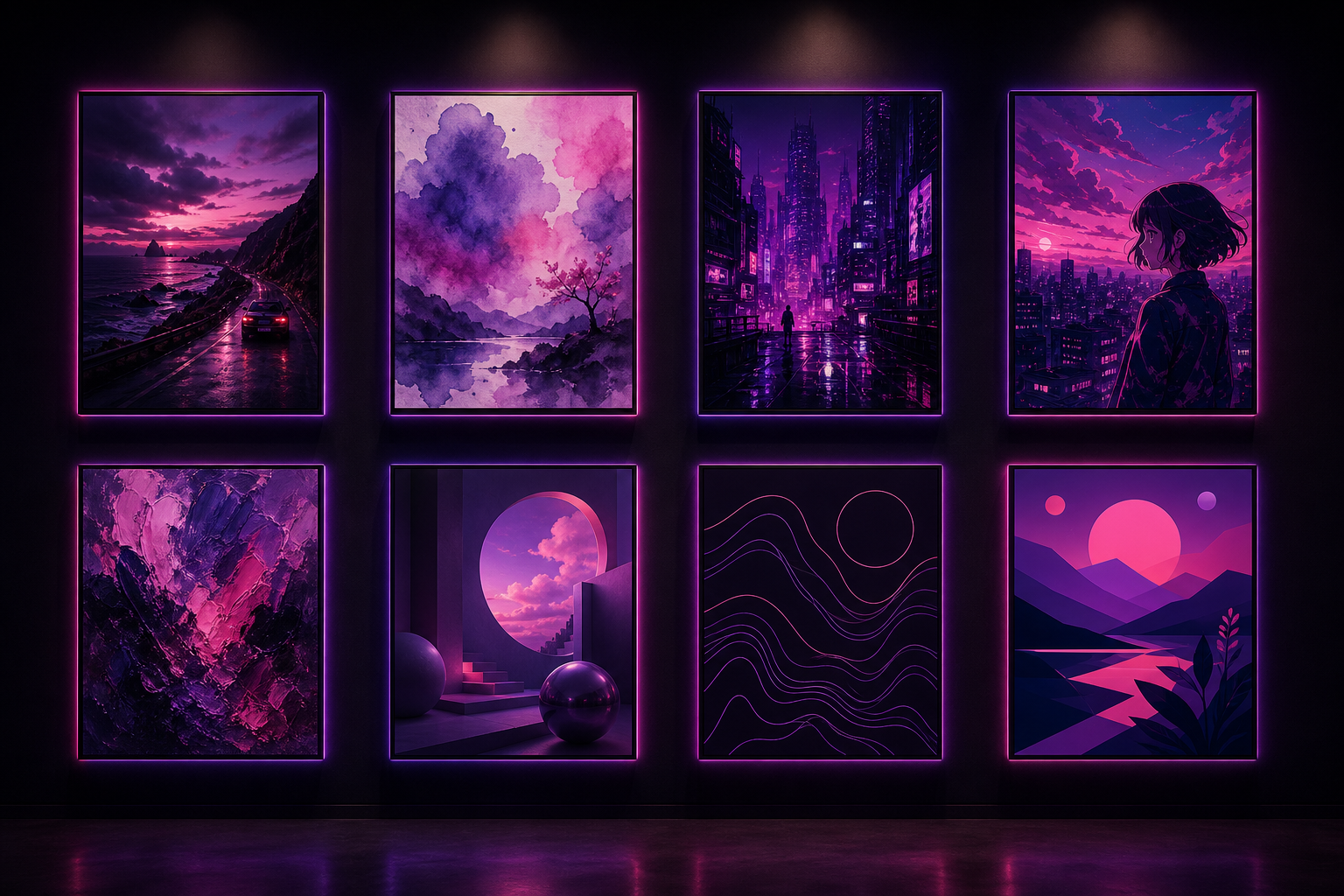
Midjourney V7 is still the reference, especially for cinematic and dreamlike scenes. FLUX Ultra owns absolute photorealism — perfect when you want a photo that looks like a real photographer's real camera. Choosing between them is a matter of taste and task, not "which is best."
ByteDance Seedream is approaching both, and Google Imagen 4 offers a strong alternative with superior language understanding. The competition is healthy — the smart artist uses more than one model as the need requires.
6. Six criteria for picking the right model
Don't trust anyone who says "this is the best." The best depends on your criteria. Six practical ones:
- Artistic quality: how impressive is the final image? Midjourney and FLUX lead here.
- Consistency: can you keep the same style/character across hundreds of images? Recraft leads.
- Text inside image: does the model render legible sentences? Ideogram leads, Gemini closing.
- Generation speed: how many seconds per image? FLUX Fast and Gemini Flash lead.
- Cost: what do you pay per 1,000 images? Seedream and Gemini Flash offer the best ratios.
- Rights: can you use outputs commercially without legal doubt? FLUX and Google offer the clearest terms.
7. The darker side: artist rights and style ethics
All this progress lives under a real shadow. Models learned from human artists — often without their permission. When you generate "in the style of an unnamed painter," you're effectively drawing on a lifetime's work without paying its owner.
Not a theoretical concern. Early 2026 brought the first European court rulings forcing AI labs to compensate artists whose work was used without consent. Ethical platforms are starting to let artists "opt out" of training datasets.
On Tamaem, we hold to strict ethical standards: the models we support respect artist rights, and our UI doesn't encourage imitation of personal styles without consent. Art isn't a sample bank — art is context and responsibility.
8. The right model for each situation
Practical shortcuts for specific scenarios:
- Ad poster with Arabic text: Ideogram 3.0 → or Gemini Image as a strong alternative.
- Brand identity for a campaign: Recraft V3 → for consistency and SVG export.
- Artistic book cover or cinematic poster: Midjourney V7 or FLUX Ultra.
- E-commerce product shot: FLUX Ultra for realism → or Seedream for speed.
- App illustrations: Recraft for stability or Midjourney for signature style.
- Fast artistic experiments on a budget: Gemini Flash or FLUX Fast.
9. A question we leave with you
If you can now generate a thousand professional images in one hour at the cost of a morning coffee — is the human designer still needed, and exactly where?
That's the question haunting the design industry. The answer we see in 2026 isn't "machine replaces designer." The answer: the designer changes. Their job is no longer to draw every pixel — it's to direct the machine, curate the best, and add the human touch at the final stage.
On Tamaem we bring the best 2026 image models into one place. You compare them side by side, pick the right one, and walk away with a result — no juggling of subscriptions. Come back and tell us: which model surprised you, and which failed your personal test?